25+ Specialist Courses

Food Safety Training:
Mastering Compliance. Ensuring Success.

Training Hero

Whether you operate a cafe, fine-dining restaurant, large-scale manufacturing facility, Aged Care centre, or Child Care facility, rigorous food safety training is non-negotiable. ANFSI delivers practitioner-led courses engineered for real compliance, not classroom theory.

Browse All 25+ Courses
25+
Specialist
Courses
6
Course
Categories
2
Delivery
Options
7
Capital
Cities
On-Site and Virtual Live Online Highly Experienced Practitioners Industry Expert Trainer
Why Food Safety Training Is Non-Negotiable

The Business Case for
Rigorous Food Safety
Training in Australia

Every food business operating in Australia is bound by the Australia New Zealand Food Standards Code, particularly Standards 3.2.1, 3.2.2, and 3.2.2A, which mandate documented food safety programmes, trained food handlers, and accountable supervisors. Compliance is not optional, it is a legal operating requirement. With foodborne illness causing over 5 million cases and 2 million missed workdays annually across the country, proper training protects both the public and your operational stability.

Beyond legal obligation, well-trained teams drive measurable business improvement: fewer incidents, higher audit scores, stronger retailer relationships, reduced waste, and a demonstrably safer product reaching consumers.

Hygienic Handling Standards

Proper temperature management, cross-contamination prevention, and allergen control embedded into daily operational habit.

Global Standards and Efficiency

Moving beyond standard compliance to advanced systems like HACCP streamlines documentation, reduces food waste, and strengthens a safety-first culture. It builds the credibility required to pass audits and secure lucrative supply contracts.

Risk Mitigation at Every Level

From food handler to QA director, structured competency reduces recall risk, regulatory exposure, and reputational damage.

Australian Regulatory Compliance

Align with Food Standards Code 3.2.2A, FSANZ Standard 3.3.1, Aged Care Quality Standards, and NDIS Practice Standards in a single programme.

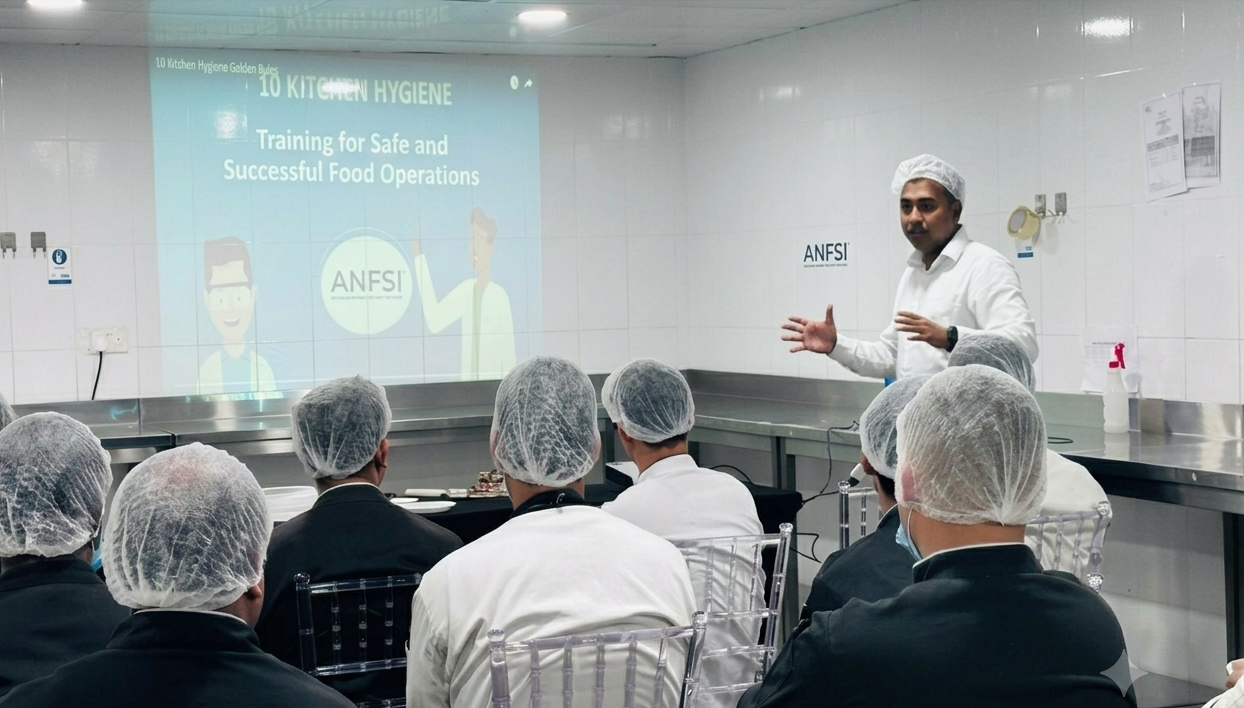
Training Session
The Real Impact of Food Safety Lapses
Vulnerable populations face severe or fatal outcomes from preventable foodborne illness
Financial penalties under Australian food law can reach hundreds of thousands of dollars per infringement
Brand reputation built over years can be permanently destroyed by a single avoidable incident or recall
What We Cover

Core Training Curriculum: Built for Australian Food Businesses

Our curriculum covers every dimension of food safety compliance relevant to Australian food businesses, from foundational hygiene to advanced quality leadership.

Hygiene Practices
Personal hygiene, handwashing, PPE, and cross-contamination prevention
Food Handling Controls
Temperature management, storage, receiving, and correct handling procedures
Regulatory Compliance
Food Standards Code 3.2.2A, FSANZ requirements and state authority obligations
HACCP Programmes
Full HACCP system design, CCP identification, monitoring, and verification
Incident Management
Recall coordination, root cause analysis, corrective action and crisis response
Allergen Management
VITAL 4.0 risk assessment, 14 major allergens, precautionary allergen labelling
Internal Auditing
GFSI and retailer standard audit skills, evidence collection and corrective action
Food Labelling
FSANZ Standard 1.2 compliance, allergen declarations, Health Star Ratings
Traceability Practices
One-up one-back traceability, mock recall exercises, retailer requirements
QA Leadership
Team leadership, influence skills, food safety culture, and management engagement
How We Deliver

On-Site or Virtual Live Online: Your Choice

Every ANFSI course is available in two delivery formats, both led by active food safety practitioners delivering the same rigorous content.

On-Site Delivery

Training at Your Facility

ANFSI trainers travel to your facility, anywhere in Australia, and deliver training in your actual operational environment. Maximum relevance, minimum disruption, with course content customised to your specific processes and compliance requirements.

No travel cost or time lost for your team
Content customised to your sector and systems
Any group size, no minimum participant count
Available nationally including regional locations
Virtual Live Online

Real-Time Online Training

Live instructor-led training delivered via video conferencing with interactive exercises, real-time Q and A, and direct access to the trainer throughout the session. Identical rigour to in-person delivery, accessible from any location in Australia or internationally.

Access from any device, anywhere in Australia
Live interaction with expert practitioner trainers
Session recordings available post-training
Ideal for geographically dispersed teams
Training Programmes

Business Improvement and Quality Management

Structured training pathways covering HACCP, allergen management, lead auditing, food safety culture, and specialist aged care compliance, all available On-Site or Virtual Live Online.

HACCP Training

Foundation through to Advanced
FoundationOn-SiteVirtual Live Online

HACCP Refresher: Essential Insights

Focused refresher for food safety professionals updating against Codex Alimentarius 2020. Covers all 12 steps, 7 HACCP principles, and current documentation requirements to bring existing plans to audit-ready standard.

Key Outcomes
Understand all 12 steps and 7 HACCP principles under Codex 2020
Identify gaps in existing HACCP plans against current requirements
Update documentation to audit-ready standard immediately
IntermediateOn-SiteVirtual Live Online

Mastering HACCP: Principles to Practice

Comprehensive course from foundational HACCP theory through to hands-on implementation. Designed for food safety coordinators, QA team members and supervisors responsible for building and maintaining HACCP plans.

Key Outcomes
Conduct a full hazard analysis across biological, chemical and physical risks
Establish CCPs, critical limits and monitoring procedures
Build a complete, defensible HACCP plan from scratch
AdvancedOn-SiteVirtual Live Online

HACCP Validation and Verification: Know When and How

The most misunderstood element of HACCP systems, explained and practiced in depth. Covers the science and methodology of validating CCPs and verifying that your HACCP plan is working in your operational environment.

Key Outcomes
Distinguish between validation and verification with confidence
Design a validation study for cooking, chilling and critical processes
Produce evidence satisfying auditors under BRCGS, ISO 22000 and TPA

Lead Auditor Skills

Prepare for auditor certification
IntermediateOn-SiteVirtual Live Online

Mastering Internal Audit: Power Up Your Skills

Internal auditing is mandatory under all GFSI-benchmarked standards yet remains one of the most poorly executed elements of food safety programmes. This course closes that gap completely from audit planning through to corrective action verification.

Key Outcomes
Plan and schedule a complete annual internal audit programme
Conduct evidence-based interviews, observations and document reviews
Write finding statements with objective evidence that withstand scrutiny
AdvancedOn-SiteVirtual Live Online

Mastering Lead Auditor Skills

Professional-standard lead auditor course for food safety professionals seeking to conduct formal third-party audits or lead complex internal audit programmes. Built around ISO 19011:2018 and national food safety auditing competency requirements.

Key Outcomes
Lead a complete food safety audit from planning through to report sign-off
Grade non-conformances across major, minor and observation categories
Manage challenging auditee behaviours while maintaining audit integrity

Allergen Management

VITAL 4.0 and Allergen Control Plans
AdvancedOn-SiteVirtual Live Online

Allergen Management: Your VITAL 4.0 Action Plan

Definitive allergen management course using the VITAL 4.0 framework. Covers all 14 major allergens, allergen risk assessment, cross-contact risk management, cleaning validation, and the VITAL 4.0 decision tool for precautionary labelling.

Key Outcomes
Apply VITAL 4.0 to assess and communicate allergen risk accurately
Design an allergen management plan including production scheduling
Validate allergen cleaning procedures with appropriate audit evidence
IntermediateOn-SiteVirtual Live Online

Food Labelling: Label It Right!

Food labelling is one of the most complex areas of Australian food law. Covers FSANZ Standard 1.2 requirements, mandatory declarations, allergen labelling, date marking, country of origin, and Health Star Rating compliance.

Key Outcomes
Review existing labels against FSANZ Standard 1.2 and identify non-compliance
Identify and correct the most common labelling non-conformances
Understand country of origin, health claim and nutrition panel requirements
AdvancedOn-SiteVirtual Live Online

Mastering Food Fraud and Defence: VACCP and TACCP

Food fraud and intentional adulteration are assessed in every GFSI-benchmarked audit. Covers VACCP for economically motivated adulteration and TACCP for intentional contamination, with complete food defence plan guidance.

Key Outcomes
Complete a documented VACCP and TACCP assessment for your site
Identify your highest vulnerability points and design appropriate controls
Satisfy food fraud requirements under BRCGS Issue 9 and FSSC 22000

Food Safety Culture

Organisational and Team-Level Culture
IntermediateOn-SiteVirtual Live Online

Food Safety Culture: Learn Your Part, Make a Difference

Food safety culture is assessed in every GFSI-benchmarked audit. This course helps all staff understand their personal role in creating and maintaining a genuine food safety culture, moving beyond compliance into values-driven behaviour change.

Key Outcomes
Understand what food safety culture means in a real food business
Identify personal behaviours that support or undermine food safety
Contribute actively to a positive food safety environment
AdvancedOn-SiteVirtual Live Online

Food Safety Culture Starts With You: A Manager's Guide

Senior leadership companion course for food safety managers and site leaders responsible for embedding culture at an organisational level. Covers culture assessment frameworks, leadership behaviours, and auditor evidence requirements.

Key Outcomes
Conduct a food safety culture maturity assessment for your organisation
Design an organisation-wide culture improvement plan
Present culture evidence under BRCGS Issue 9 and FSSC 22000 requirements

Aged Care and Vulnerable Groups

Specialist catering compliance training
FoundationOn-SiteVirtual Live Online

Food Safety Basics for Serving Vulnerable Groups

Essential knowledge for food handlers working in aged care, hospitals, disability support, and similar settings. Covers heightened risks for immunocompromised individuals and enhanced controls required under Australian food safety law.

Why vulnerable populations face greater food safety risk
Enhanced hygiene and temperature controls for high-risk settings
Compliance with FSANZ Standard 3.3.1 requirements
IntermediateOn-SiteVirtual Live Online

Safe Food Handling When Serving Vulnerable Groups

Practical course for kitchen supervisors, Cook-Chill operators, catering coordinators, and meal delivery personnel. Covers Cook-Chill protocols for vulnerable settings, modified texture food safety, and regulatory documentation.

Identify high-risk foods not served to vulnerable populations
Cook-Chill temperature protocols for vulnerable group catering
Complete documentation to meet audit and regulatory expectations
AdvancedOn-SiteVirtual Live Online

Aged Care Food Safety Supervisor Training

Professional-level food safety supervisor course for managers, head chefs, dietitians, and food service coordinators in residential aged care. Covers the full regulatory framework, Food Safety Programs for aged care kitchens, and incident management.

FSANZ Standard 3.3.1 and Aged Care Quality Standards compliance
Train and supervise kitchen staff to meet all regulatory requirements
Prepare your facility for regulatory TPA audits with confidence
Featured Specialist Course
IntermediateOn-SiteVirtual Live Online

Essential Kitchen Hygiene for Aged Care and NDIS Providers

Duration
04 Hours
Delivery
On-Site or Virtual Live Online
Certificate
Downloadable and Printable

This course addresses the critical and clinically important role food safety plays within aged care and NDIS settings. Aged care kitchens and disability support food service environments face the strictest regulatory scrutiny in Australia, with FSANZ Standard 3.3.1, NDIS Practice Standards, and Aged Care Quality Standards all imposing legally enforceable obligations. A single food safety lapse in these environments can have severe consequences for residents and service users whose immune systems cannot mount an effective defence. This course equips your team with the knowledge, systems, and habits to prevent those consequences.

Course Outline

Regulatory Framework: FSANZ Standard 3.3.1 and Aged Care Quality Standards
Vulnerable Populations and High-Risk Pathogens: Listeria, Salmonella, and more
Cleaning vs. Sanitising: Understanding the critical operational distinction
Specialised Food Preparation for IDDSI Texture Modified Diets
Allergen and Dietary Cross-Contamination in Aged Care Settings
Chemical Safety and Correct Storage of Cleaning Agents
Personal Hygiene Standards for High-Risk Food Service Environments
Validation and Verification Logs: Building a compliant evidence trail
Fostering a Food Safety Culture in Care Settings: Leadership behaviours and team accountability

Core Learning Outcomes

Apply clinical food safety standards specific to aged care and NDIS environments
Implement documented cleaning, sanitation, and allergen control procedures
Prepare compliant validation and verification documentation for regulatory auditors
Lead a food safety culture within your care setting, embedding staff accountability
Who Should Attend
Head Chefs and Cooks Kitchen Assistants Food Service Coordinators Aged Care Facility Managers NDIS Support Workers Dietitians and Nutritionists Catering Contractors Registered Nurses with food oversight
Recommended Foundation

No formal prerequisite is required to enrol. However, participants with a foundation in food safety will gain more. We recommend completing one of the following first:

SITXFSA005 Use Hygienic Practices for Food Safety
ANFSI Food Safety Basics for Serving Vulnerable Groups (foundation level)
Key Benefits
Clinical Safety Built Into PracticeReduces foodborne illness risk for the most vulnerable Australians through embedded daily habits, not periodic checklists
Repeatable, Documented SystemsEvery task becomes a documented process, creating the evidence trail needed for audits and regulatory reviews
Pass Regulatory Audits with ConfidencePrepare your team and your documentation to satisfy TPA auditors, Aged Care Quality reviewers, and NDIS Commission inspectors
Certificate of Completion
Every participant receives a ANFSI certificate of completion, downloadable, printable, and ready to include in your staff training register and regulatory audit evidence files
Scroll to Top